Photography in Jumeirah, Dubai: the Complete 2026 Guide
Published: 8 September 2026 · Last updated: 8 September 2026
Reviewed by Jumeirah Car Rental
30 best spots, permits, pro settings, legal rules, and a half-day shooting route — everything you need to shoot Jumeirah properly, personal or commercial.
Quick Answer
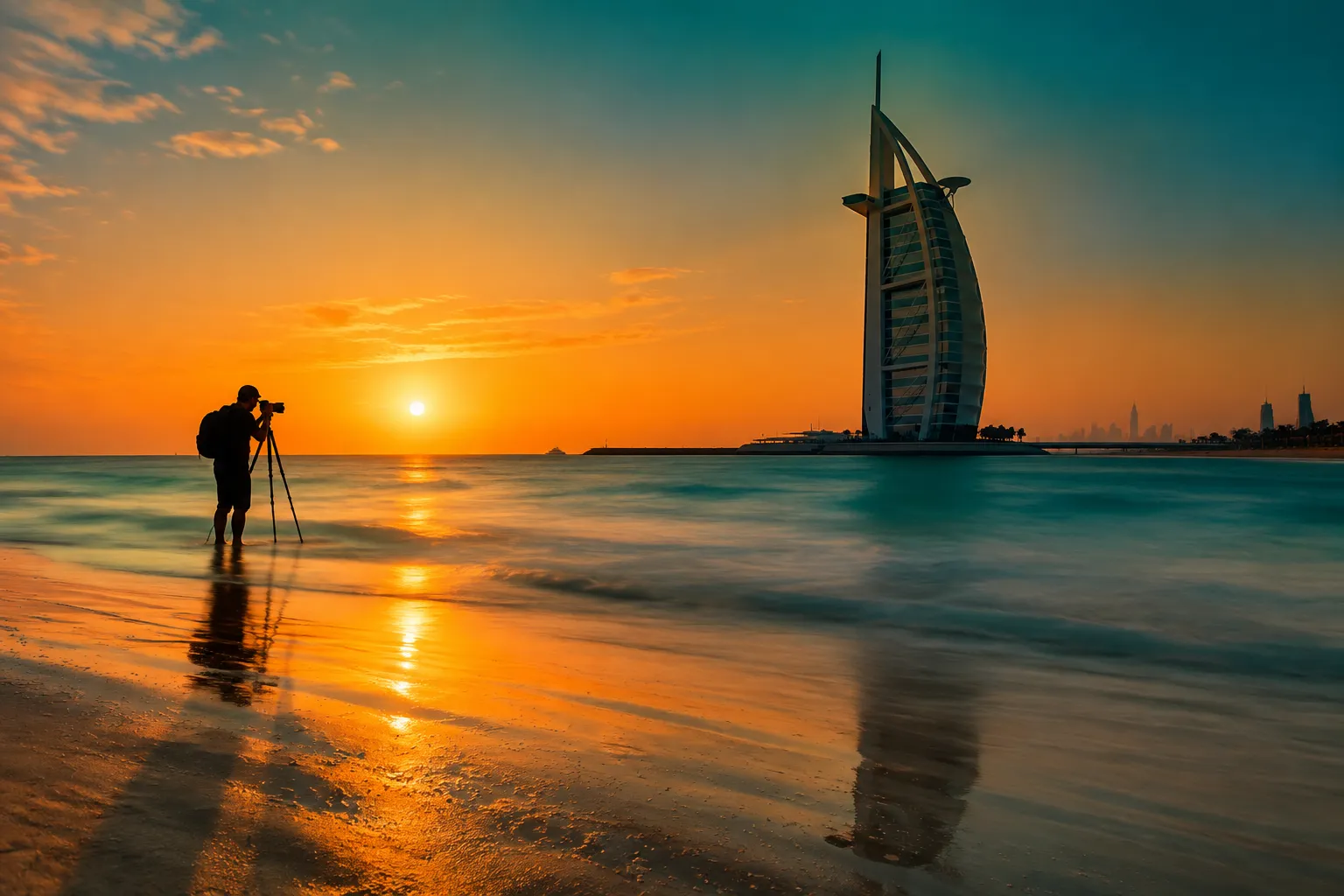
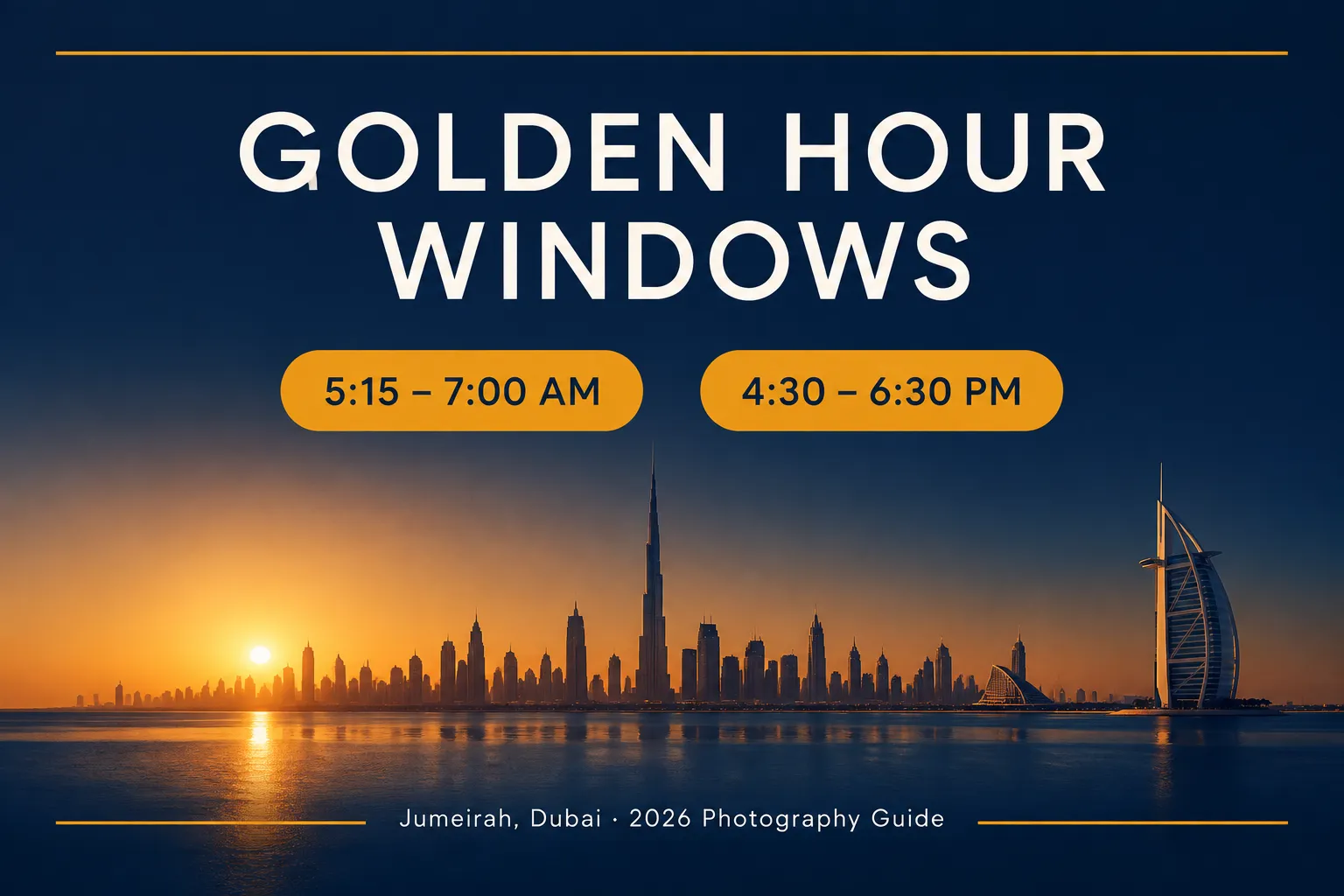
The top Jumeirah photography locations are Sunset Beach, the Burj Al Arab foreshore, Madinat Jumeirah’s waterways, and Jumeirah Mosque. Personal photography needs no permit; commercial shoots require a DFTC location permit totalling AED 3,040 (AED 520 application + AED 2,520 public location fee). Drones need prior GCAA/DCAA authorisation — recreational drone flights over Dubai’s residential and beach areas remain suspended until further notice, and commercial flights need a DCAA No-Objection Certificate. Optimal light windows: 5:15–7:00 AM and 4:30–6:30 PM.
Why Jumeirah Photographs Differently
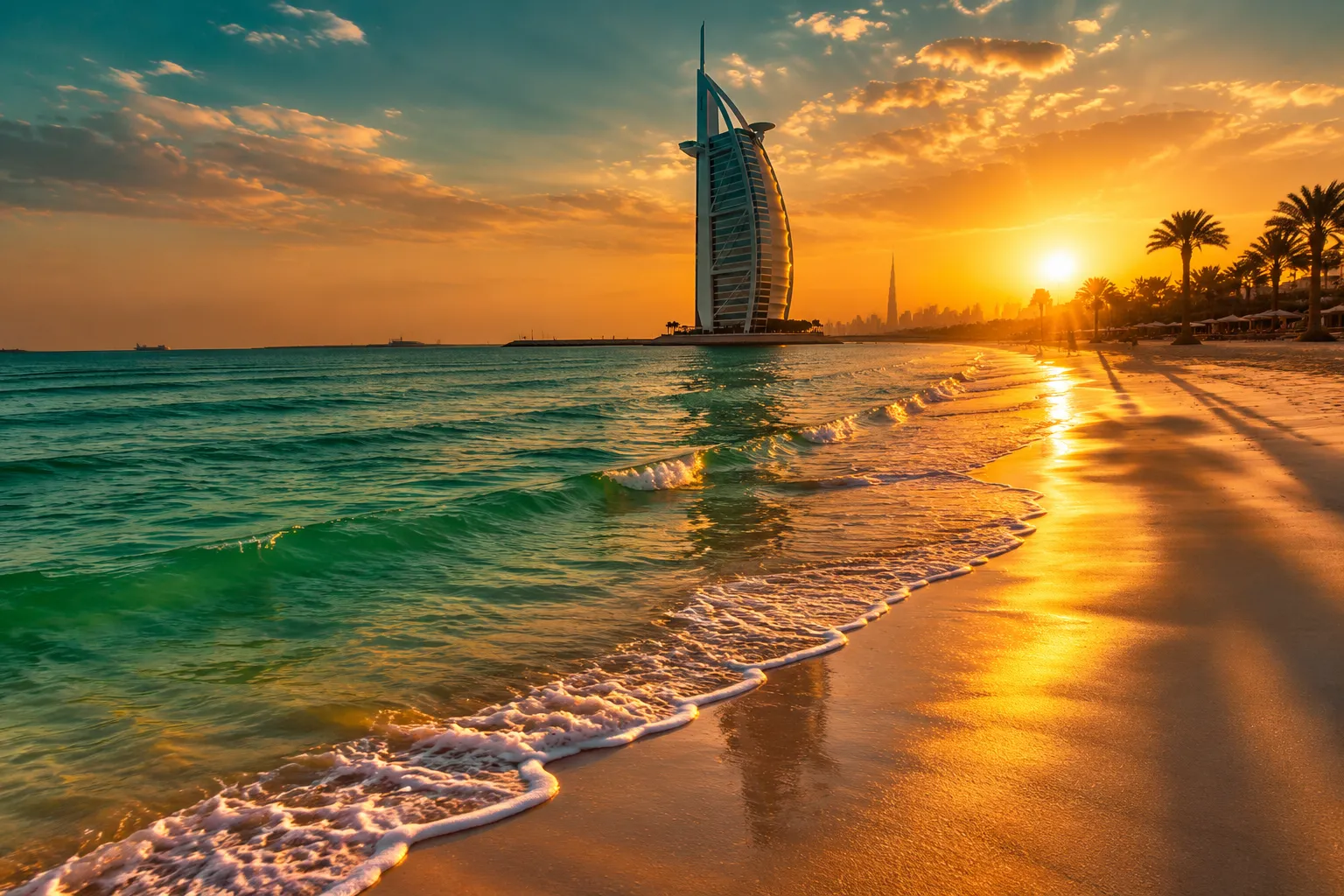
Jumeirah sits at a latitude where golden hour lasts roughly 40 minutes longer than in European cities, and the coastline runs northeast–southwest — so both sunrise and sunset fire directly along the beach instead of behind you. The Persian Gulf’s shallow water turns a translucent jade green in morning light that vanishes completely by 10:00 AM.
A first shoot that starts at 10:30 AM comes back with flat, hazy, unusable frames — every photographer who has worked this coast learns it the same way. After roughly 9:30 AM, the light is essentially dead for most subjects until the sun drops below 30° again around 4:00 PM. Build your schedule around that window and Jumeirah rewards you like few other coastal cities.
Permits & Legal Requirements
Personal vs. commercial photography
| Type | Permit required | Cost | Authority |
|---|---|---|---|
| Personal / editorial | No | Free | — |
| Commercial (brand, product, film) | Yes | AED 3,040 | DFTC |
| Drone (any use) | Yes — prior authorisation | Varies | GCAA + DCAA |
| Inside mosques | Written permission | Free | Awqaf |
Commercial permit breakdown (2026): the Dubai Film and TV Commission (DFTC) location permit is a non-refundable AED 520 application fee plus a AED 2,520 standard public-location fee — AED 3,040 total. Commercial photography without a permit falls under the UAE’s federal media regulation framework (Federal Decree-Law No. 55 of 2023), applied locally in Dubai through the Dubai Media Council under Law No. 29 of 2024. Reported fines start around AED 10,000 for a first offence and rise for repeat violations, alongside possible equipment confiscation. Apply through DFTC at least 5 working days before your shoot.
Privacy & cultural sensitivity
Federal Decree-Law No. 34 of 2021 (Combating Rumours and Cybercrimes), Article 44, prohibits photographing identifiable individuals without consent in a way that infringes their privacy — confirmed penalties are imprisonment of at least six months and/or a fine of AED 150,000 to AED 500,000. This targets identifiable faces in street photography, not general crowd scenes, and the UAE recognises no blanket “public place” exception.
Two other laws matter here: Federal Decree-Law No. 38 of 2021 governs copyright over the images themselves, and Federal Decree-Law No. 45 of 2021 (the Personal Data Protection Law) is relevant if you post geo-tagged images that reveal private villas, vehicle plates, or other identifying details.
Practical rules: never photograph security installations or government buildings from an angle that could suggest surveillance intent, never shoot mosque interiors without written Awqaf permission, and always ask before pointing a telephoto lens at individuals in traditional dress near mosques or markets.
Drone regulations (GCAA / DCAA)

- Recreational drone flying remains suspended across all of Dubai “until further notice” under the Dubai Civil Aviation Authority — this covers Jumeirah’s entire residential belt and beaches, and applies even to a registered personal drone.
- Commercial drone operations resumed on 30 June 2026 after an industry-wide pause, but require a DCAA No-Objection Certificate for the specific project, dates and location.
- Maximum altitude with an approved NOC: 400 ft AGL in approved corridors.
- Fines for unauthorised flight: AED 50,000 – AED 500,000.
- Apply through the DCAA DroneZone portal — commercial NOC applications are best submitted well in advance rather than on short notice.
Best Times & Seasons
Golden hour (year-round priority): 5:15–7:00 AM and 4:30–6:30 PM. The low sun angle gives long shadows on architecture and warm specular hits on the water simultaneously — a combination nearly unique to flat coastal desert cities.
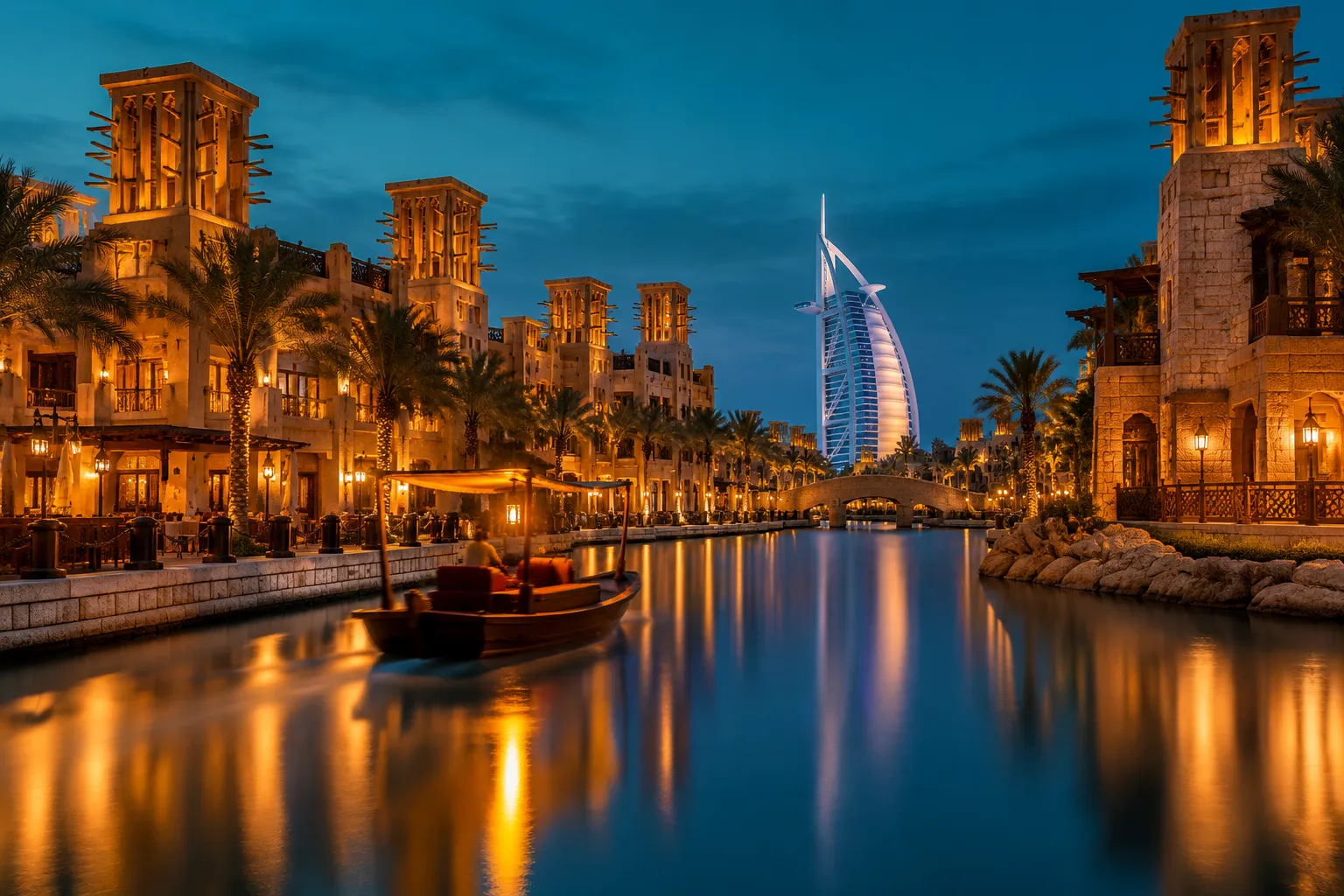
Blue hour: 30–45 minutes after sunset. Madinat Jumeirah’s illuminated waterways against a deep teal sky is one of the most reproducible premium compositions in Dubai.
- October–April (optimal): humidity below 60%, minimal haze, calm sea.
- May–September (harsh): heat shimmer visible by 8:00 AM; viable only for pre-sunrise golden hour.
- Winter mornings (Dec–Feb): occasional sea mist before 6:30 AM adds atmospheric depth to long-exposure beach shots — unpredictable but worth monitoring.
The 30 Best Photography Locations
Zone 1 — Beaches & Coastline
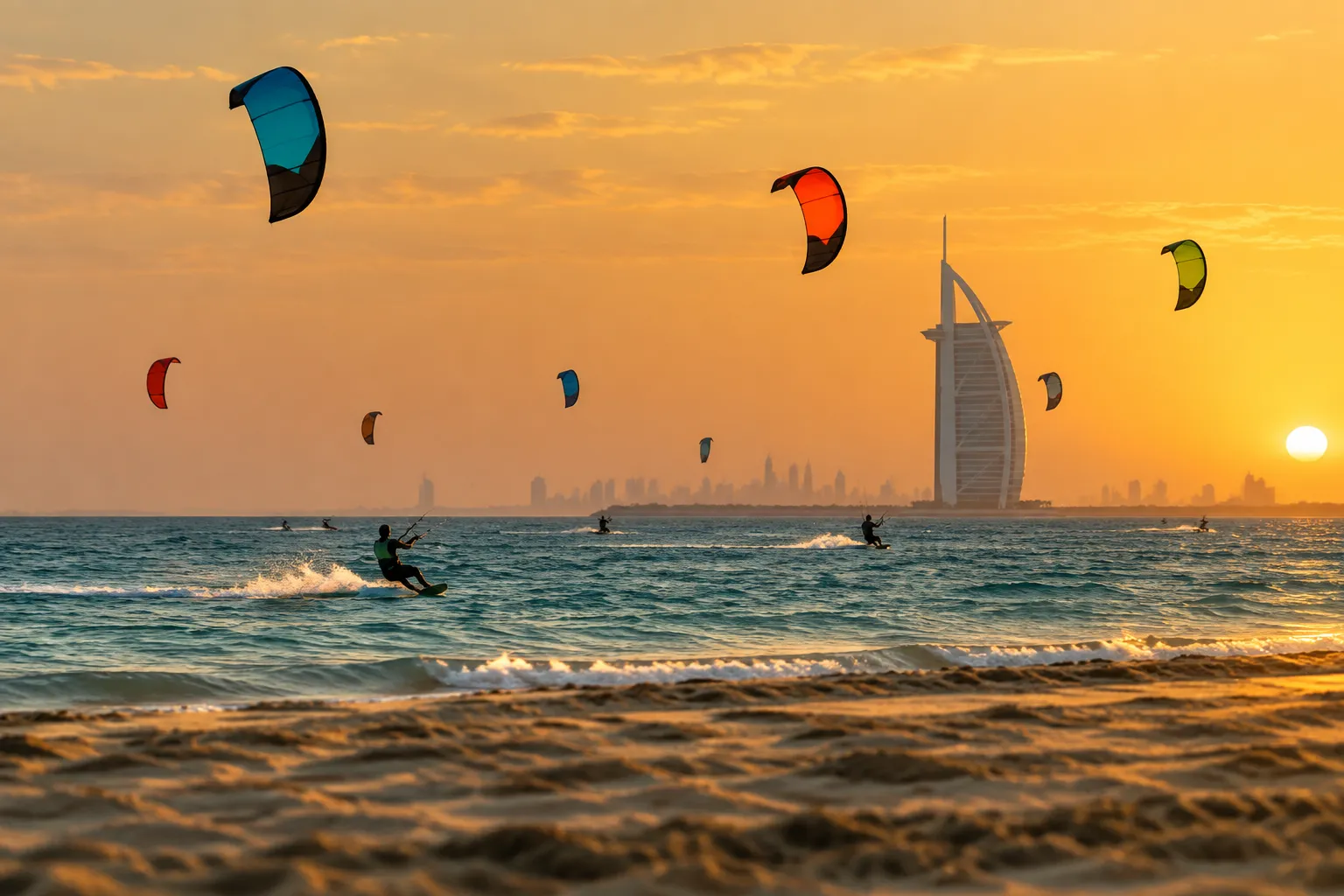
- Sunset Beach (Umm Suqeim Beach) — 25.1297° N, 55.1764° E. The most-photographed Burj Al Arab foreground. Stand in the shallow water at the northern tip: Burj on the right third, sea in front, clear sky left. 24–35mm, best at 5:30 AM with a 2-second exposure to smooth the surface. Paid parking at Umm Suqeim Park (RTA: USQ-01).
- Kite Beach — 25.1158° N, 55.1866° E. Wide sandy foreground, kite-surfers as mid-ground subjects, Burj Al Arab in the distance. 70–200mm compresses the layers; late-afternoon side-light separates kites from sky. Arrive by 5:00 AM for empty frames on weekends.
- Black Palace Beach (Al Sufouh) — 25.0954° N, 55.1502° E. Uncrowded, faces southwest for exceptional sunsets. Rocky outcrops allow classic seascapes with 10-stop ND filters. No facilities; park on Al Sufouh Road.
- La Mer Beach — 25.2067° N, 55.2481° E. Colourful murals plus a built boardwalk make strong architectural-lifestyle compositions. Best mid-morning with a street-photography approach; good for editorial and travel content.
- JBR Open Beach (northern boundary) — technically Jumeirah Beach Residence, but connects to the Jumeirah coastline. The Marina skyline at blue hour from the sand: 24mm, 20–30s, f/8, ISO 100.
- Umm Suqeim Park Shoreline — 25.1350° N, 55.1800° E. Glass-calm bay with a small wooden pier for elevated foreground geometry — excellent reflections on still mornings.
- Al Mamzar Beach (south tip) — further north but within greater Jumeirah. Long curving beach with date palms as foreground frames; richest colour October–March.
- Safa Park Lakeside — 25.1826° N, 55.2259° E. An inland freshwater lake with mature trees, rare in Dubai — skyline reflections on still mornings, and one of the city’s most underused landscape compositions.
Zone 2 — Icons & Architecture
- Burj Al Arab Foreshore (eastern base) — 25.1412° N, 55.1853° E. The hotel’s access road is gated, but the eastern beach (Jumeirah Beach Hotel side) gives clean sightlines at 200–400mm. Sunrise fires directly behind the sail in January–February.
- Jumeirah Beach Hotel Facade — 25.1367° N, 55.1893° E. The wave-profile architecture shoots cleanly from the southern beach access path; pair with the Burj Al Arab behind for the classic two-structure shot.
- Madinat Jumeirah — the waterways — 25.1317° N, 55.1801° E. The most architecturally complex location in Jumeirah: abra boats on the canal, Barjeel wind-towers reflected in still water, and the Burj Al Arab framed between buildings at 200mm. Blue hour is exceptional; a commercial permit is needed for the elevated walkways — coordinate with the property’s media desk.
- Souk Madinat Jumeirah interior — warm amber lighting, brass lanterns, wooden lattices. Manual exposure: ISO 800–1600, f/2.8, 1/125s. Works in any weather, any time of day.
- Mall of the Emirates — Ski Dubai facade — 25.1182° N, 55.2004° E. A snow dome behind palm trees — genuinely surreal. Best at blue hour when the interior ski-slope lights glow through the translucent panels. 35mm, shot from the car-park ramp.
- City Walk District — 25.1988° N, 55.2356° E. Contemporary architecture, street art, open-air retail, clean lines and pastel facades — strong for lifestyle and fashion editorials without a restricted-access permit.
- Boxpark — adjacent to City Walk. Shipping-container retail with strong graphic geometry; available light at dusk renders the neon well with a 50mm at f/2.
Zone 3 — Mosques & Heritage
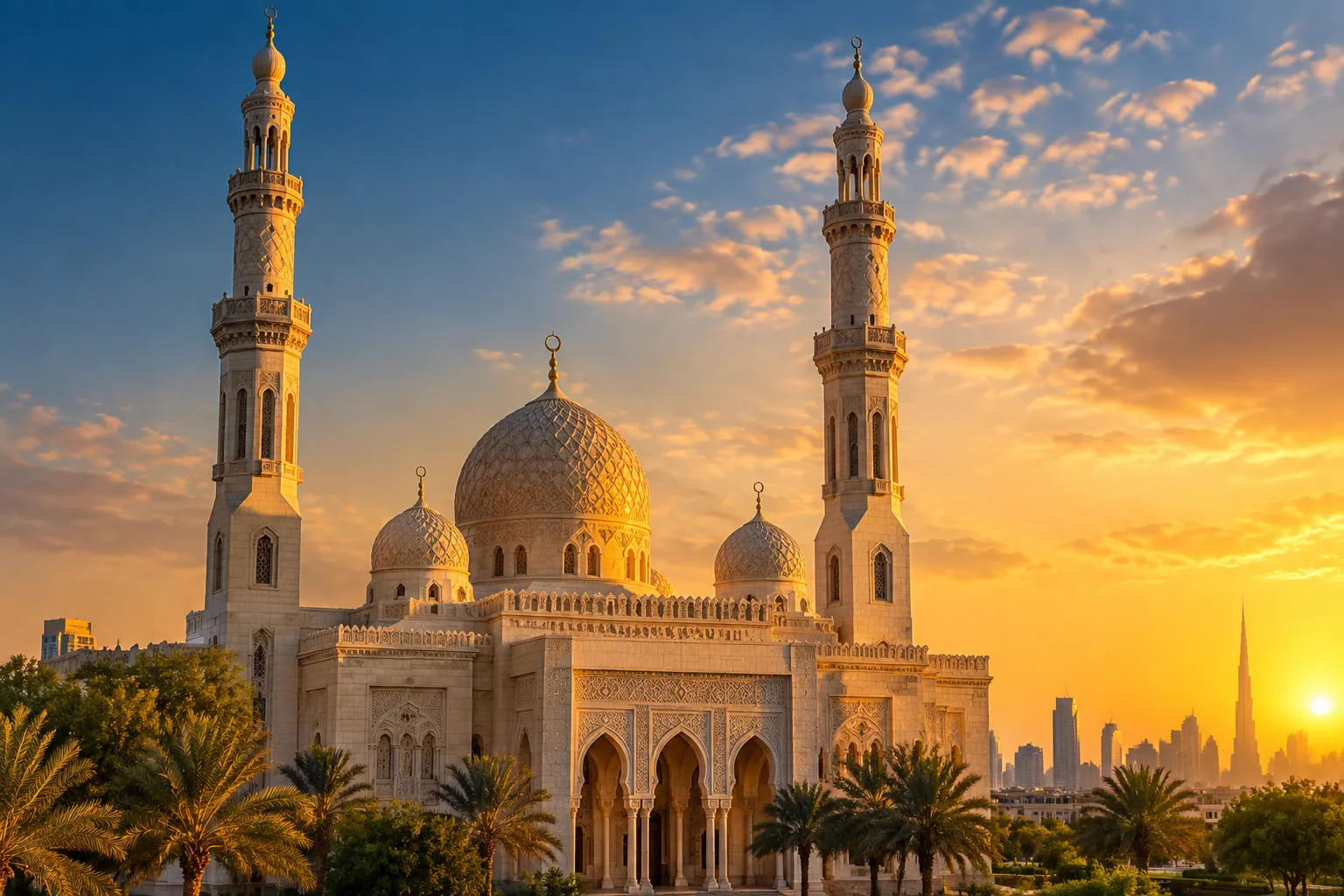
- Jumeirah Mosque — 25.2323° N, 55.2608° E. Dubai’s most photographable mosque and the only major one open to non-Muslims on selected mornings. The white Fatimid stone shines in the 15-minute window after sunrise when raking light defines every carved surface. Commercial work needs written Awqaf permission; personal shots are fine from the public pavement. 50–85mm.
- Al Safa Mosque — a quieter neighbourhood mosque with more intimate compositions possible, and authentic ambient audio from the morning call to prayer for video work.
- Heritage Village (Jumeirah) — 25.2419° N, 55.2806° E. Reconstructed traditional barasti houses and a dhow-building yard on the creek — strong historical documentary potential, especially on overcast days when diffuse light softens the shadows inside the open structures.
- Dubai Frame (from Zabeel Park) — 25.2326° N, 55.3016° E. The 150m gold frame reads as a picture frame around old Dubai to the north and new Dubai to the south. Best at blue hour from the Zabeel Park side; 24mm captures the full frame with the foreground garden.
- Al Fahidi Historical Neighbourhood — 25.2631° N, 55.2977° E. Wind-towers, coral-block walls, narrow alleys — the best traditional architecture photography in Dubai. Morning light from the east catches the tower faces; commercial work is frequently approved by the Al Fahidi Cultural District authority with a simple application.
Zone 4 — Streets, Lifestyle & Detail
- Jumeirah Beach Road (JBR) street murals — Dubai’s most accessible outdoor gallery. Best photographed mid-morning with side-light; 35–50mm for graphic close-ups.
- Al Wasl Road urban geometry — modern facades, palm-lined medians and strong leading lines; a clean 24mm urban composition set during golden hour.
- Jumeirah Corniche Walkway — the promenade railing and streetlamps create repetition patterns ideal for minimalist compositions, strongest at blue hour.
- Mercato Facade & surroundings — Tuscan-style architecture in a residential setting; a playful contrast against the palms, better at dusk with the interior glow.
- Port de La Mer Boardwalk — La Mer’s lifeguard towers frame playful lifestyle shots with the open Gulf behind.
- Dubai Water Canal (east edge of Jumeirah) — the canal bridge and pedestrian walkway give clean cityscape lines, with moving pedestrian light trails at night (15–30s exposures).
- Jumeirah Islands Waterfront — quiet villa canals with mirror-still water; a “hidden Dubai” seascape with reflections of private villas (respectful framing only, telephoto from public paths).
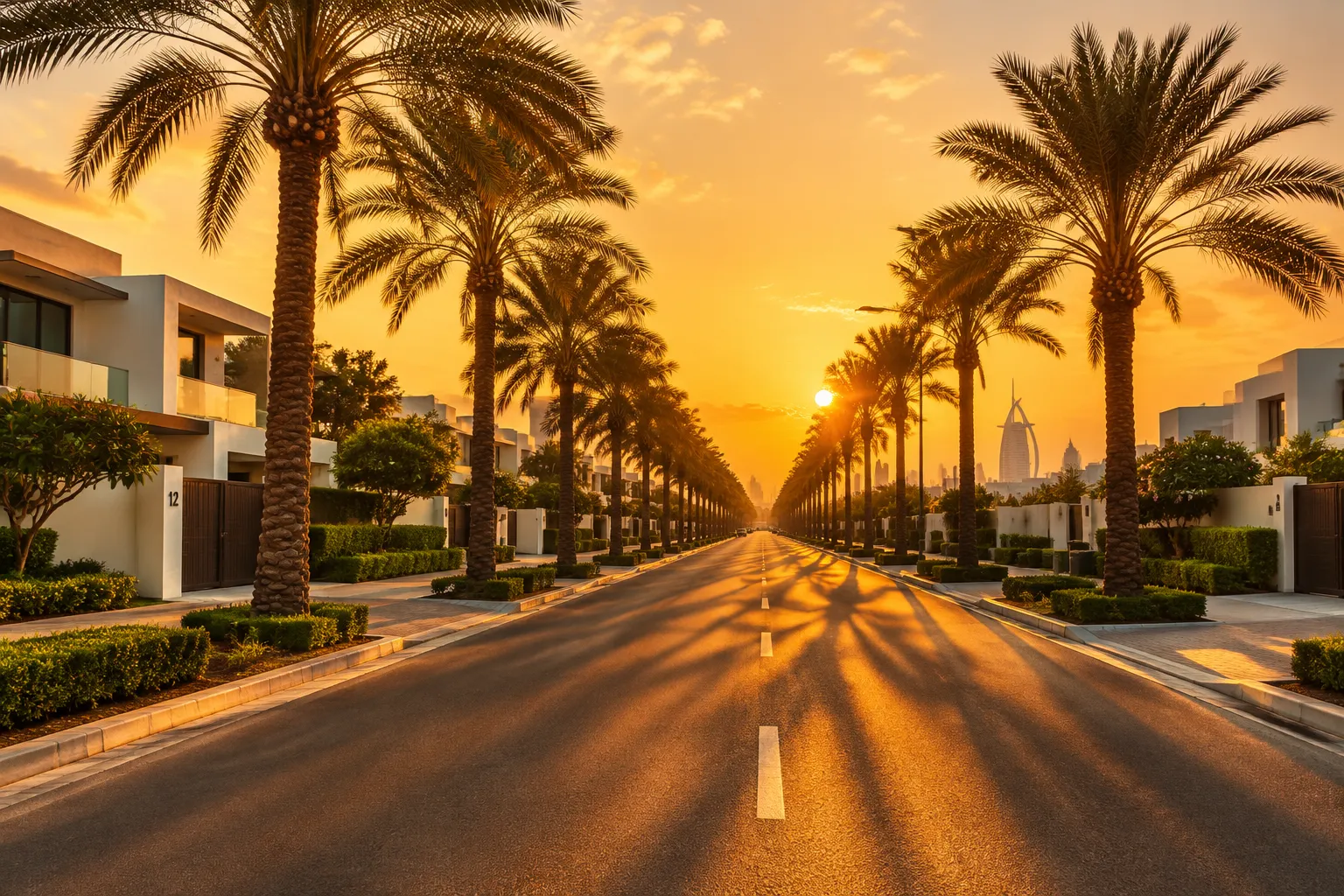
- Umm Suqeim 2/3 villa streets — long palm-lined residential avenues with dramatic single-point perspective, ideal for golden-hour leading-line compositions from the pavement.
- Safa / Al Barsha overpass views — elevated walkways over Sheikh Zayed Road give the classic elevated traffic-light-trail cityscape (tripod, ND filter, 30s).
- Jumeirah Beach Promenade detail shots — lifeguard towers, signage, surfboards, seagulls — the street-photography layer of the district that gives travel editorials their point-of-view frames.
Camera Settings: Working With “Dubai Light”
| Scenario | ISO | Aperture | Shutter | Notes |
|---|---|---|---|---|
| Golden-hour landscape | 100 | f/8–f/11 | 1/125–1/250s | Bracketed ±1 stop |
| Golden-hour portrait | 100 | f/2.8 | 1/250s | Raking backlight, lens hood |
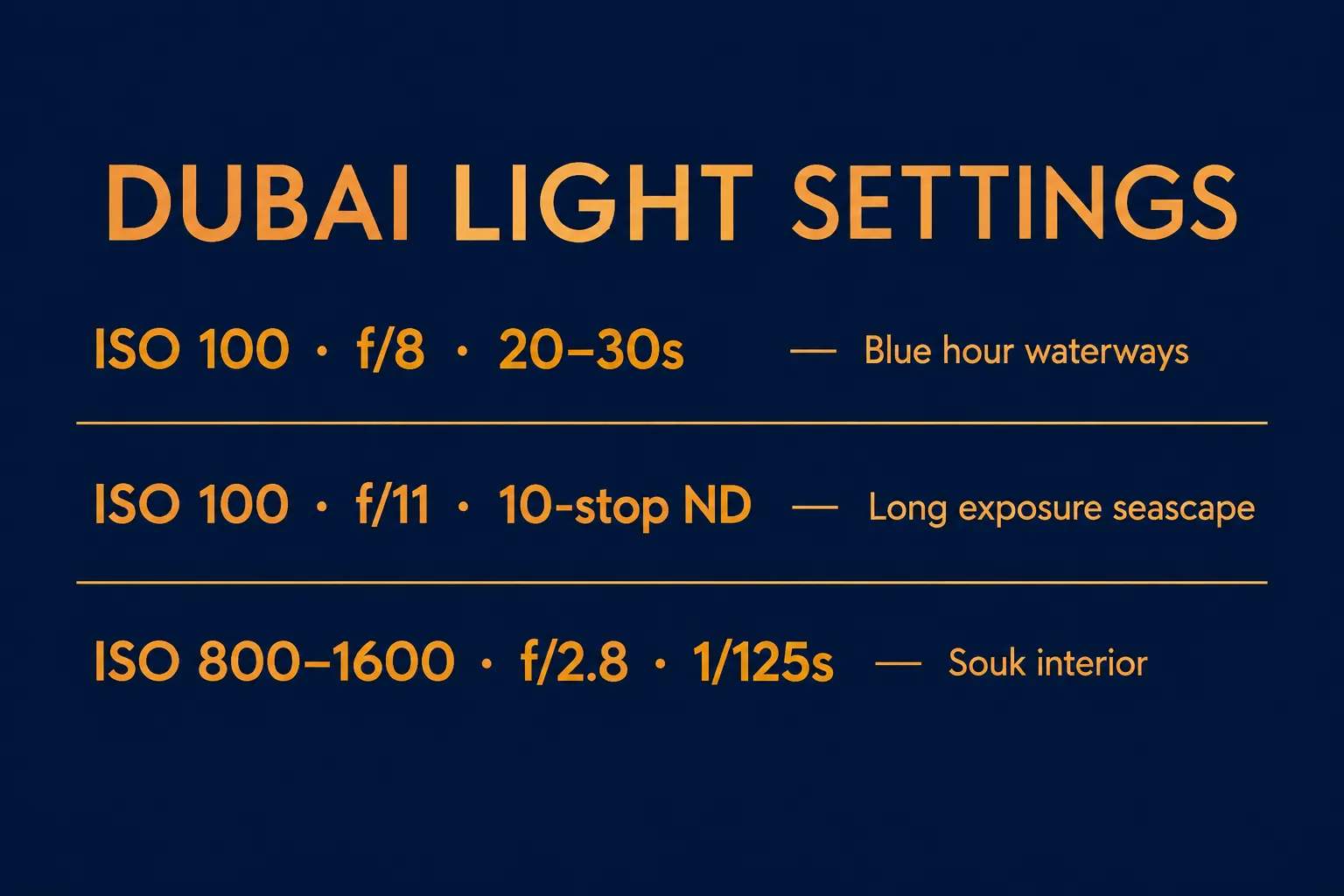
| Blue-hour waterways | 100 | f/8 | 20–30s | Tripod mandatory, 2s delay |
| Long-exposure seascape | 100 | f/11 | 30s–2min | 10-stop ND, mirror lock |
| Night street detail | 400–800 | f/2.8 | 1/30–1/60s | Image stabilisation on |
| Souk interior | 800–1600 | f/2.8 | 1/125s | Bounce flash off ceiling |
Coastal heat haze & humidity (May–Sep): shimmer degrades foreground contrast from around 8:00 AM; shoot pre-sunrise only, or add a 1/4 Black Pro-Mist filter for atmosphere that hides the mush. Keep gear in a sealed dry bag between sets — humidity is the real camera killer in Dubai.
Phone photography: lock exposure manually, tap to focus, and shoot RAW via a third-party app during the same golden-hour windows — a clean 24mm phone frame at 5:30 AM on Sunset Beach outperforms a mid-day full-frame image.
Field Walk-Through: the Half-Day Route
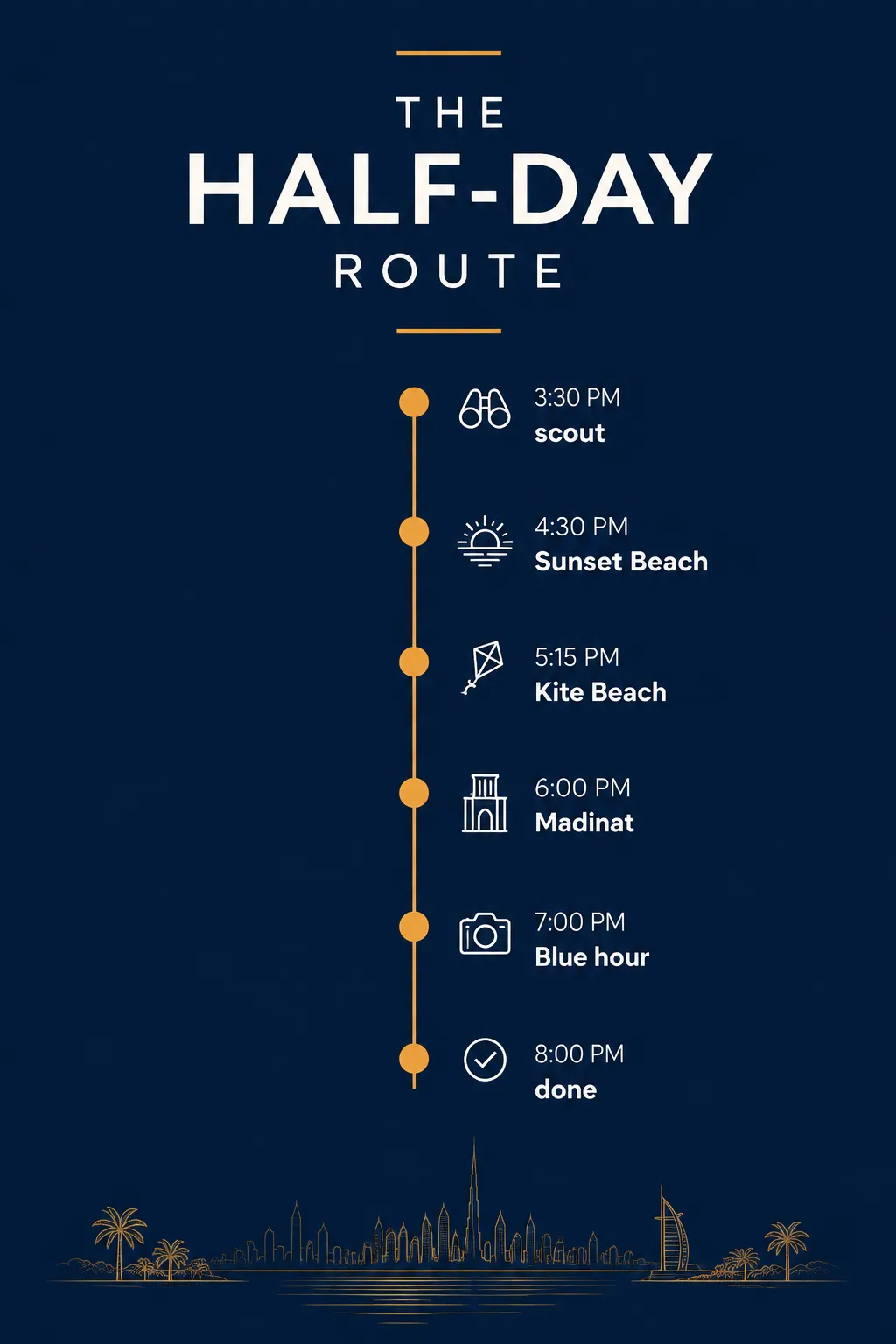
For personal or editorial work, this route hits four strong sets in one evening without any permit requirement.
- 3:30 PM — pre-light scouting. Drive Zone 1: check the Sunset Beach tide and the surf crowd at Kite Beach. Park at Umm Suqeim (USQ-01).
- 4:30 PM — golden hour at Sunset Beach. Wide-angle seascape first, Burj Al Arab on the right third. You only get about 15 minutes of usable frames before the light moves on.
- 5:15 PM — Kite Beach side-light. 70–200mm compression on the kites and the distant Burj.
- 6:00 PM — Madinat Jumeirah. Position for the abra-and-Barjeel reflection shot before the crowds thin.
- 6:30–6:45 PM — sunset burst from the Madinat boardwalk.
- 7:00–7:30 PM — blue hour. Waterways glow; then the Souk interior on the way out — 20–30s exposures on a tripod.
- 8:00 PM — done. Four clean sets, no midday heat, no permits needed.
Commercial workflow: file your DFTC application at least 5 working days ahead, attach the location plan and insurance certificate, and note “no restricted area” for every location on the form — then run the identical route with your client and collect release forms for any identifiable faces under Federal Decree-Law No. 34 of 2021.
The route covers roughly 20 km end to end once you add Zabeel Park or Al Fahidi to the day — driving yourself, rather than booking separate rides between each stop, is what actually makes a route like this possible before the light window closes. See parking and gear notes below for each stop.
Practical Essentials & Gear Protection
| Parking | RTA code | Notes |
|---|---|---|
| Umm Suqeim Park | USQ-01 | Paid, closest to Sunset Beach |
| Kite Beach | KT-02 | Early arrival before 5 AM |
| La Mer | LM-04 | Mall parking, covered |
| Madinat Jumeirah | MJ-00 | Valet available |
| Zabeel Park | ZB-03 | For the Dubai Frame |
Gear checklist
UV filter on every lens (dust and salt), silica gel packs in the bag, a sealed dry bag for beach sets, lens wipes, spare batteries (heat drains them fast), ND10 and ND64 filters, and a lightweight tripod.
Etiquette
Ask before photographing people in traditional dress, don’t set up tripods on private beach concessions, and leave no trace at unmanaged spots like Black Palace Beach.
Frequently Asked Questions
Do I need a permit for personal travel photos?
No. Only commercial shoots require a DFTC permit, which totals AED 3,040.
Can I fly my drone on the beach?
Effectively no. Recreational drone flights remain suspended across Dubai until further notice, and Jumeirah’s beaches and residential belt are no-fly zones without a commercial DCAA NOC. Fines range from AED 50,000 to AED 500,000.
What happens if I shoot commercially without a permit?
Fines have been reported starting around AED 10,000 for a first offence, rising for repeat violations, plus possible equipment confiscation, under Dubai’s media regulation framework.
Can I photograph Jumeirah Mosque?
Yes — exterior shots from the pavement are fine for personal use. Interior shots and any commercial work need written Awqaf permission.
Is street photography of people legal?
Be careful. Federal Decree-Law No. 34 of 2021, Article 44, means identifiable faces photographed without consent can carry fines of AED 150,000–500,000. General crowd scenes without identifiable individuals are generally fine.
When is the best time to shoot?
Golden hour, 5:15–7:00 AM and 4:30–6:30 PM. October–April is the prime season for clear, low-haze conditions.
What settings work for Madinat Jumeirah at blue hour?
ISO 100, f/8, 20–30 seconds on a tripod — the most reliable premium frame in Dubai.
What if I only have a phone?
Lock exposure manually, shoot RAW, and use the same golden-hour windows — a phone frame from Sunset Beach at 5:30 AM will outperform a mid-day full-frame image.
Conclusion
Jumeirah in 2026 is one of the most concentrated photography districts in the UAE once you know its rhythm. Personal photography is free and open; commercial photography is regulated but straightforward — one DFTC application, five working days, AED 3,040. Shoot the golden windows, respect the privacy laws, keep the drone grounded, and the district hands you its best frames on a schedule you can set your watch to. Plan for dawn, and Dubai delivers.
30 spots, one sunrise window — bring your own wheels.
Sunset Beach, Madinat Jumeirah, Al Fahidi and Zabeel Park sit far enough apart that hopping between them by taxi eats into your golden-hour minutes. A rental car with free delivery to your hotel or villa means you control pickup time for a 4:00 AM start, park your own gear securely between sets, and chase the light on your own schedule — not a driver’s.
Sources and methodology
Permit fees and process are referenced to the Dubai Film and TV Commission (DFTC). Privacy, copyright and data protection citations are referenced to the UAE’s official legislation portal: Federal Decree-Law No. 34 of 2021 (Combating Rumours and Cybercrimes), Federal Decree-Law No. 38 of 2021 (Copyright and Neighbouring Rights), and Federal Decree-Law No. 45 of 2021 (Personal Data Protection Law). Dubai media licensing references Federal Decree-Law No. 55 of 2023 and Dubai Law No. 29 of 2024. Drone rules are referenced to the GCAA and DCAA. GPS coordinates, compositions and settings are editorial field notes — treat them as starting points, not guarantees, since conditions change by season and tide.
- Dubai Film and TV Commission (DFTC) — location permits
- UAE Legislation portal — federal decree-laws
- GCAA — national drone regulations
Disclaimer: permit fees, drone rules and legal penalties change. This guide is general information, not legal advice — confirm current requirements with DFTC, GCAA/DCAA, or a licensed local advisor before a commercial shoot.