

Rental Car Fines in Dubai: the 2026 Renter’s Guide
Published: 8 September 2026 · Last updated: 8 September 2026
Reviewed by Jumeirah Car Rental
Getting hit with an unexpected fine weeks after returning a rental car in Dubai is one of the most common complaints from visitors and residents alike. You enjoy a smooth trip, hand back the keys, and then a charge for a few hundred dirhams appears on your credit card statement without warning.
This guide breaks down exactly how the system works, why the delay happens, what a typical charge is actually made up of, and how to protect yourself before, during and after a rental in Jumeirah or anywhere else in Dubai.
In the UAE, a traffic violation is tied to the vehicle’s licence plate, not to the driver’s personal licence. That single fact explains almost everything in this guide, including why fines surface late and why only the rental company can settle them.
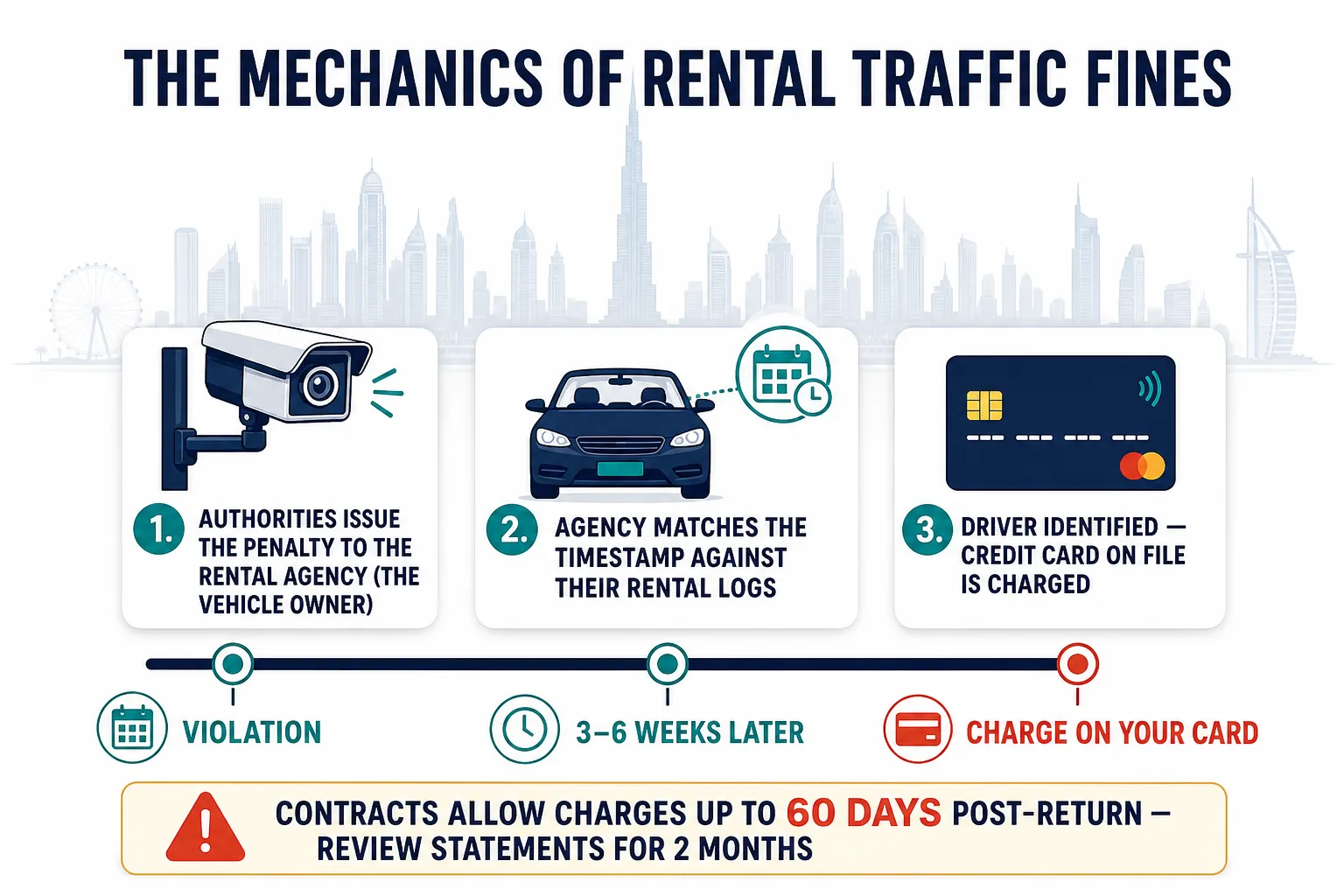
How rental car fines actually work
Radar and red-light cameras in Dubai record the vehicle, not the person behind the wheel. For a private car that is simple: the fine lands on the owner’s traffic file. For a rental car, an extra step sits in between.
- The violation is recorded against the plate. Dubai Police or the RTA log the fine to the vehicle’s traffic file, exactly as they would for any other car.
- The rental company cross-references the timestamp. Their booking system checks who had the car out at the exact date and time of the violation.
- The driver is identified and charged. Once matched, the company bills the fine, plus its own handling charge, to the card on file.
Because this matching happens manually in most companies, and because cameras themselves take time to process, you often will not see a violation until three to six weeks after it happened.
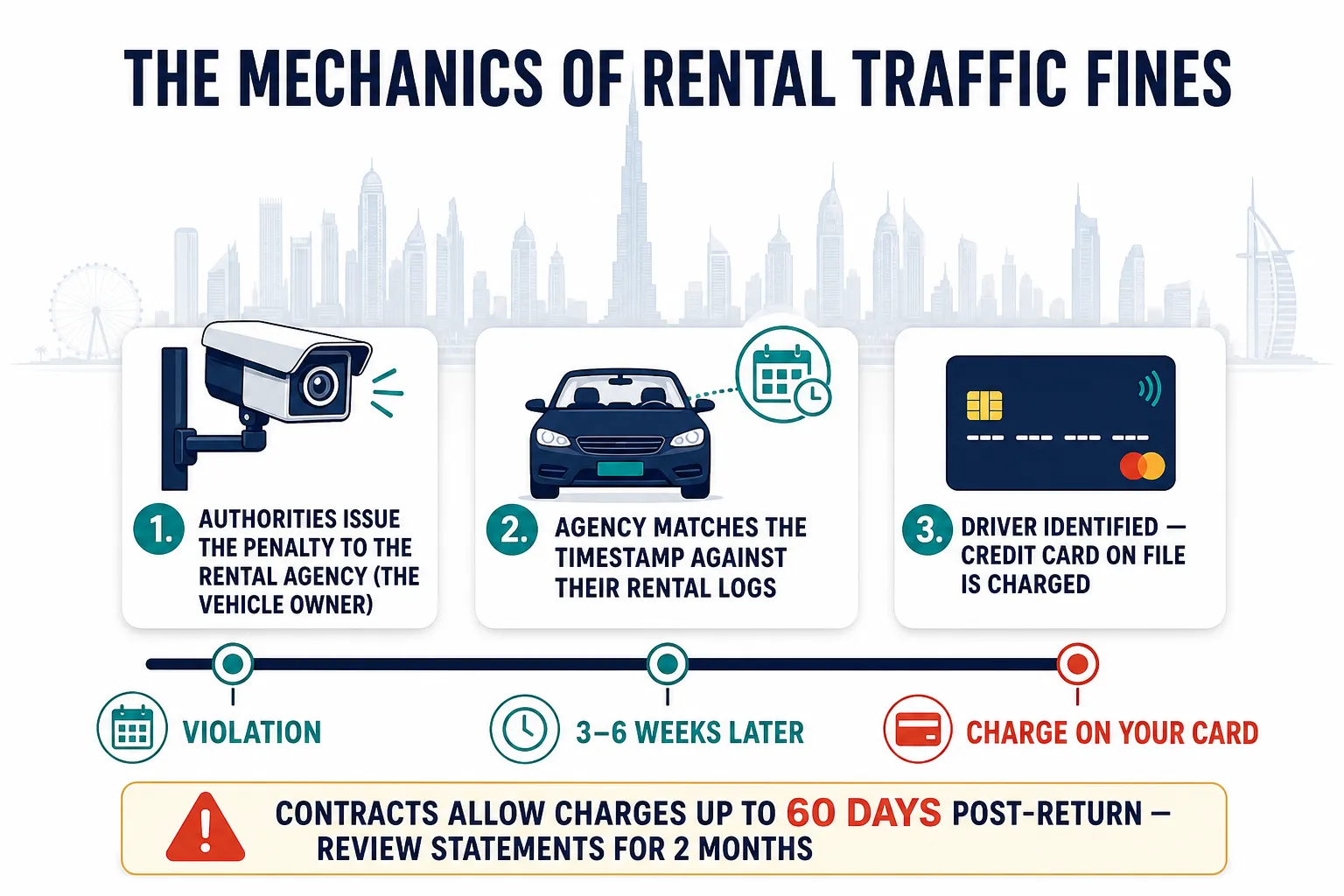
Expert insight: most rental agreements allow the company to charge your card up to 60 days after the vehicle is returned. Set a calendar reminder to check your statement for at least two months after any Dubai rental.
This delay is exactly why a documented, itemised rental agreement matters from day one — see our guide to the documents required to rent a car in Jumeirah for what should be confirmed in writing before you drive off.
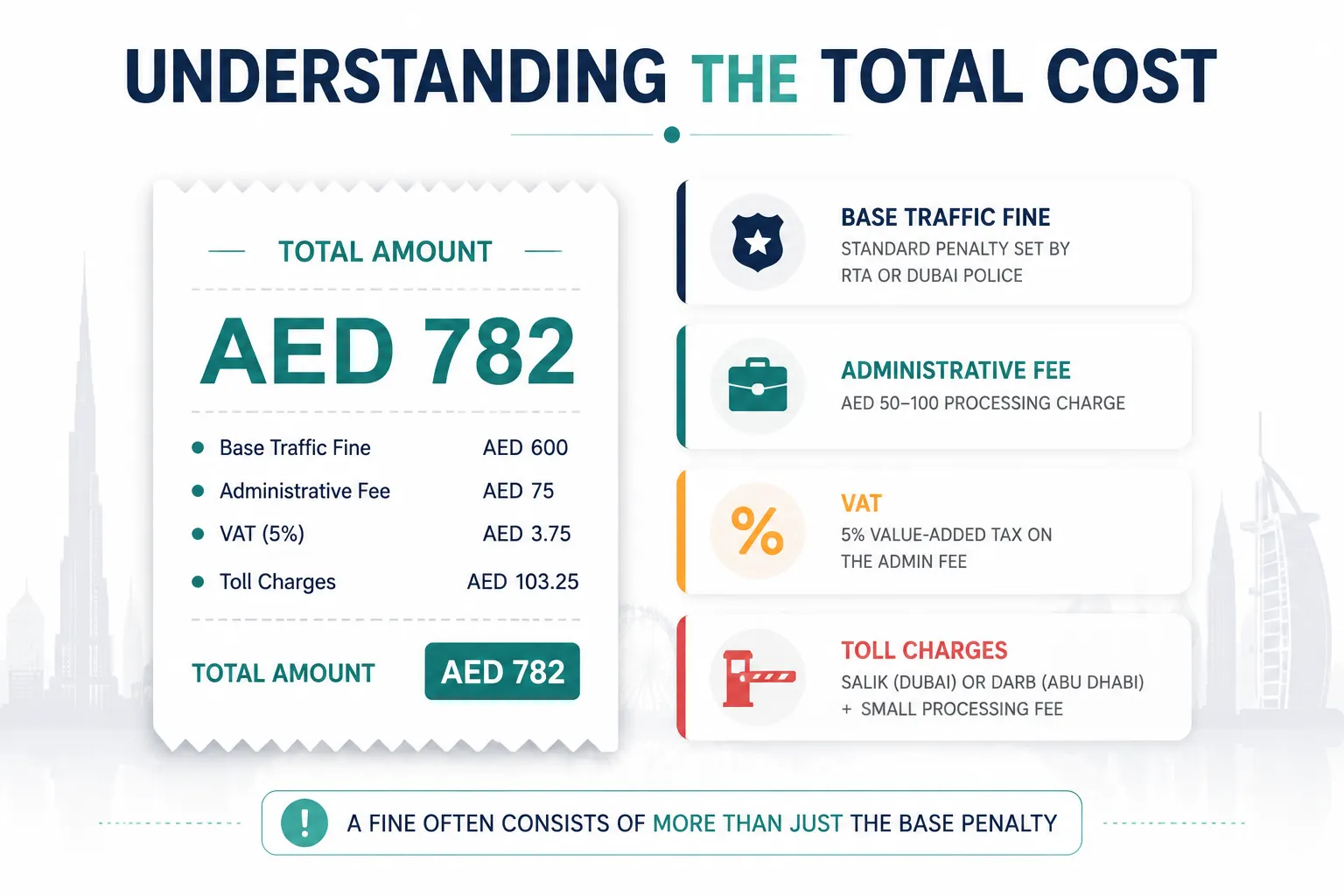
What you are actually paying
A simple speeding ticket is rarely just the cost of the fine. When a charge for something like AED 782 appears on your statement, it is usually made up of four separate components.
| Component | What it covers |
|---|---|
| Official traffic fine | The base amount set by Dubai Police or the RTA for the violation itself. |
| Administrative fee | Usually AED 50–100, charged for the rental company’s staff time to process the violation against their commercial traffic file. |
| VAT | 5% tax applied specifically to the administrative fee, not to the government fine itself. |
| Road tolls | Salik crossings in Dubai or Darb crossings in Abu Dhabi, sometimes carrying a small processing markup from the rental company. |
The government fine amount is fixed and identical everywhere. The administrative fee is the one component that varies by rental company — ask what it is before you sign.

Before you return the car
Most disputes over fines come down to one question: did the violation happen during your rental period, or after? A few minutes at drop-off can settle that question permanently.
- Photograph the “No Fines” screen. If the counter agent checks the plate on the RTA or Dubai Police system at handover, take a timestamped photo of that result.
- Request a signed check-in sheet. Ask the agent to note the odometer reading, fuel level and confirm in writing that the account shows no pending fines at the moment of return.
- Keep the rental agreement and inspection report. These are your evidence if a violation is later billed for a date outside your rental period.
Why the deposit is held
The security deposit is a temporary hold on the main driver’s credit card. It exists specifically to cover fines or tolls that surface after you have already left the country.
When it gets released
A hold of around 14 days is common, though the exact timing depends on the rental company, your bank, and whether any road charges are still outstanding.
Use a credit card, not a debit card, for the security deposit. A credit card hold does not touch your actual cash — a debit card hold freezes real funds in your account until it clears. If you are trying to avoid a card deposit altogether, see our guide on renting a car in Jumeirah without a credit card.
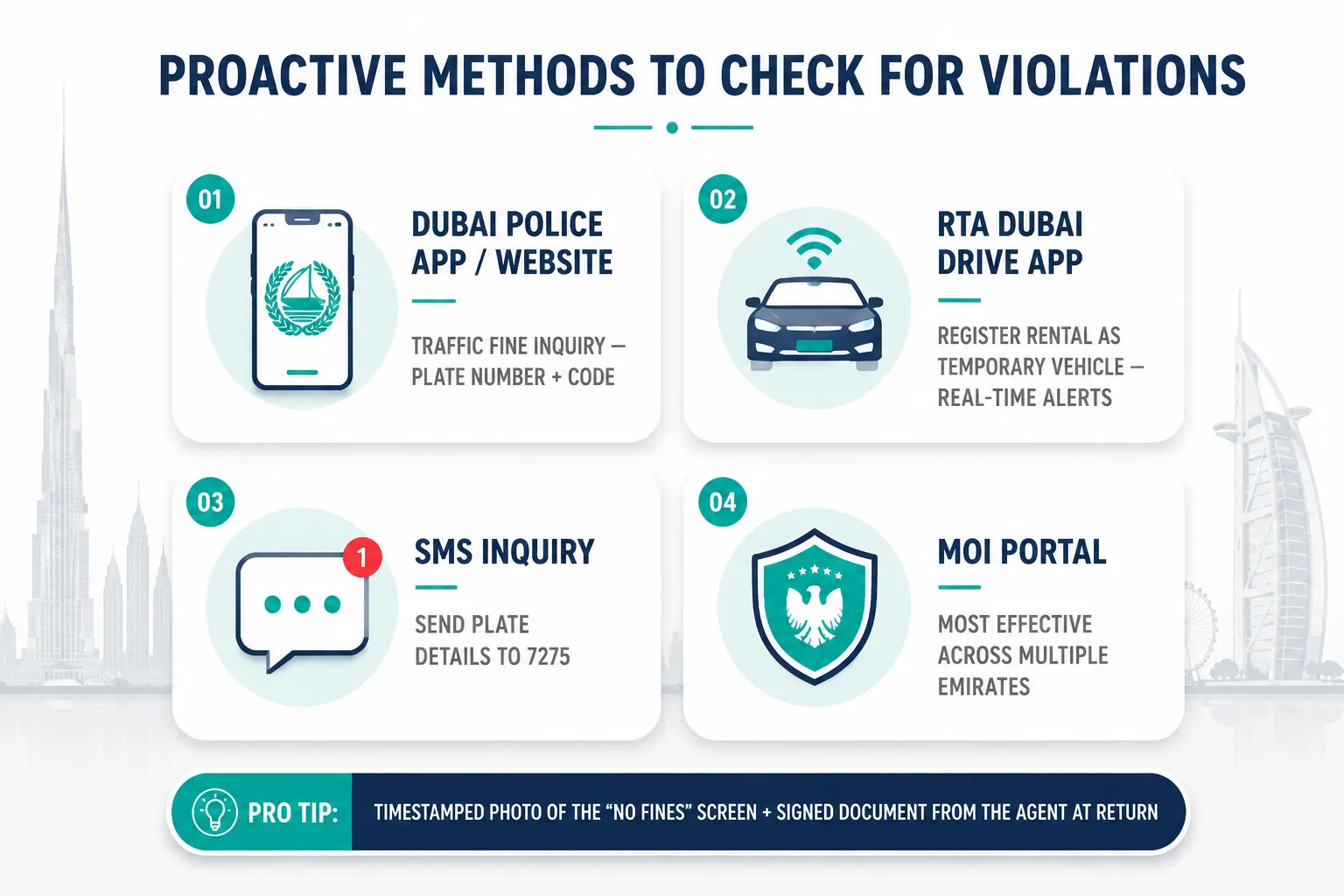
How to proactively check for fines
Do not wait for a charge to appear on your card. You can check the status of any Dubai-plated vehicle through official channels, free of charge, at any time.
Dubai Police website or app
Use the “Traffic Fine Inquiry” tool with the plate number and plate code to see every outstanding violation against that vehicle.
RTA Dubai Drive app
Add the rental car as a temporary vehicle under your profile to receive real-time notifications for the dates you actually had it.
SMS service
Some fine-check services let you text the plate number to 7275 for an instant summary. Confirm the current format on the RTA site before relying on it.
Ministry of Interior portal
The best option if your trip crossed into other emirates, since it consolidates violations recorded outside Dubai as well.
Pro tip: always take a timestamped photo of the “No Fines” screen when you return your rental, and ask for a signed statement from the agent confirming the account is clear. This is your strongest defence against a disputed charge later.
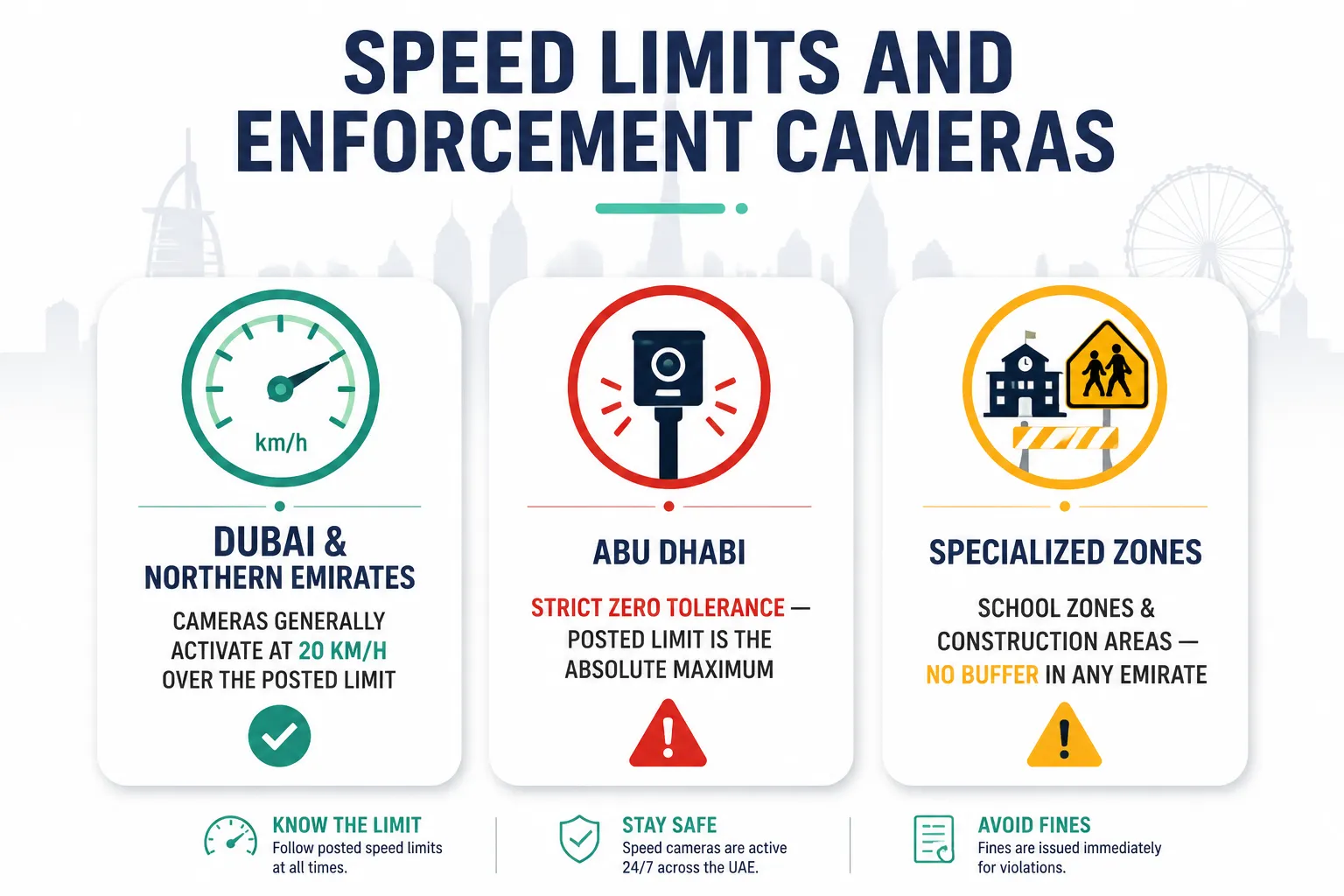
Understanding speed limits and cameras
The “20 km/h buffer” is one of the most widely repeated pieces of Dubai driving folklore. It is worth understanding, and it is not something to plan your driving around.
Dubai and most Northern Emirates
Fixed radars have widely been reported to allow roughly 20 km/h above the posted limit before triggering. This margin is not an official legal allowance, is not guaranteed on every camera, and can be tightened or removed without notice — including during fog, heavy rain, or on roads using dynamic electronic speed signs.
Abu Dhabi
Abu Dhabi enforces the posted limit with effectively zero tolerance. If your rental journey crosses the emirate border, treat every speed sign as the strict maximum, not a starting point.
School zones and active construction areas frequently run zero tolerance regardless of the emirate, and enforcement has been reported to be tightening across the board. The only genuinely safe approach is to drive to the number on the sign, not to a margin you read about online.
Driving from Dubai into Abu Dhabi requires a real shift in habit. A margin that feels normal on Sheikh Zayed Road inside Dubai can turn into an automatic fine within a few hundred metres of the emirate border.
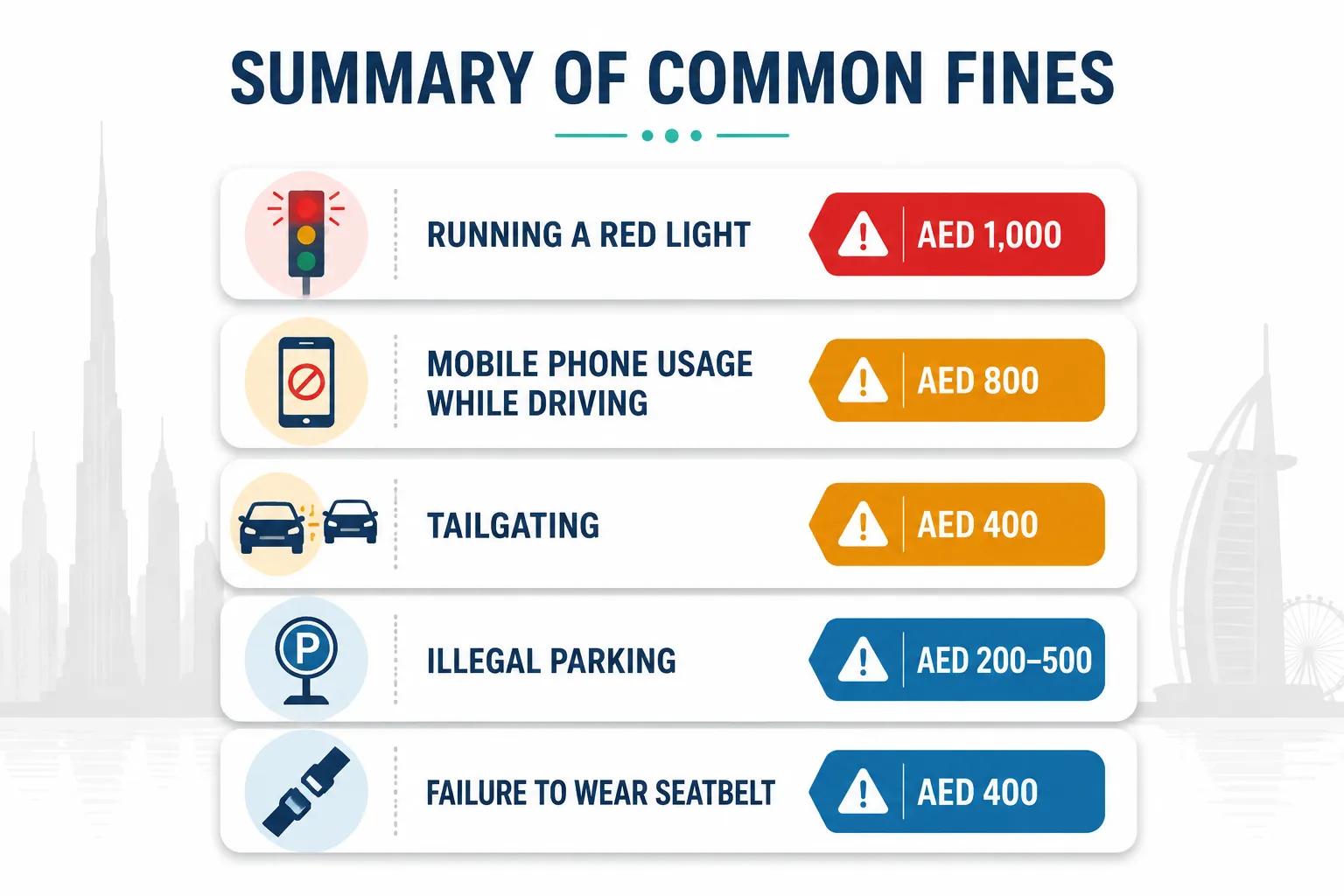
Common traffic fines
These are the violations that show up most often on rental car accounts in Dubai. Amounts are the official government fine only — your rental company’s administrative fee and VAT are added on top, as explained above.
| Violation | Typical fine (AED) |
|---|---|
| Running a red light | 1,000 |
| Using a mobile phone while driving | 800 |
| Tailgating | 400 |
| Illegal parking | 200–500 |
| Not wearing a seatbelt | 400 |
Speeding fines scale with how far over the limit you were and can carry black points and vehicle confiscation at the highest bands — always confirm the current schedule on the RTA or Dubai Police site, since amounts are revised periodically.

Resolving a disputed fine
If a violation is billed for a date outside your rental period, or for a car you were not driving, you do have a path to resolve it — but the paperwork does the work, not the phone call.
- Contact the rental company first, with your signed return inspection report and rental agreement dates ready to show.
- Ask them to check the violation timestamp against their own booking system — this is usually enough to resolve a genuine mismatch.
- File a formal objection if needed. If the company does not resolve it, Dubai Police accepts fine objections through their official channels, typically within 30 days of the violation being issued.
This is exactly the kind of situation where renting from a company that keeps clear digital records pays off — it is also covered in our broader look at the hidden costs of renting a car in Jumeirah, alongside deposits, Salik handling and insurance excess.
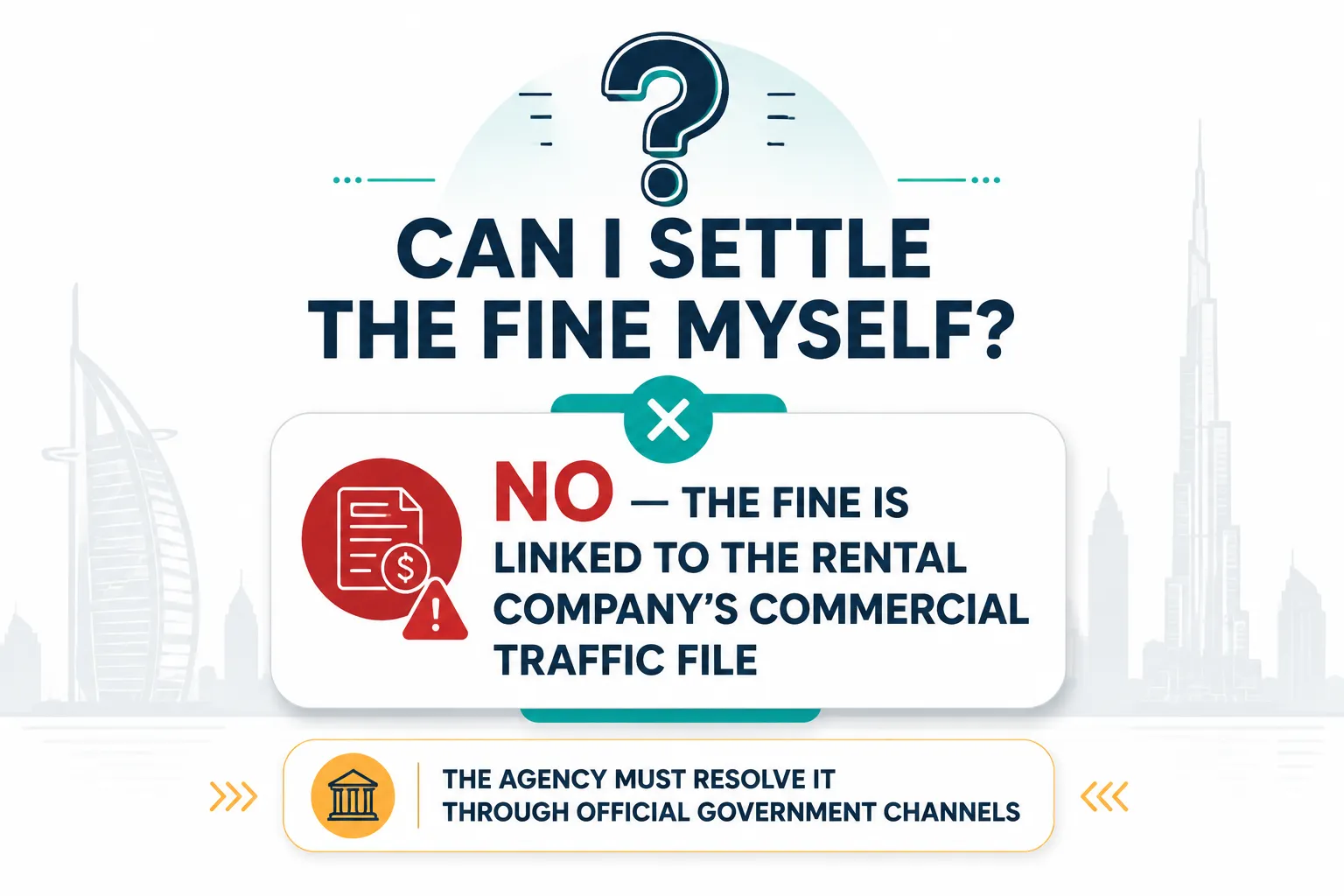
Frequently asked questions
Can I pay the fine myself to avoid the admin fee?
No. Because the fine is registered against the rental company’s commercial traffic file rather than your personal one, only the company can settle it through official government channels.
Do black points transfer to tourists?
Black points are tied to the vehicle’s traffic file rather than a foreign licence, so they will not usually appear on your home country’s record. Severe or repeated violations can still lead to a blacklist within the UAE rental system, and unpaid fines have been linked to entry issues on future visits.
What should I do if I receive an unfair fine?
If the violation occurred outside your rental period, contact the rental agency immediately with your signed return inspection report. If they cannot resolve it, Dubai Police accepts formal objections within 30 days of the violation.
Why was my security deposit held longer than expected?
Rental companies commonly keep the deposit hold active for around 14 days to cover any late-surfacing fines or tolls. If you used a debit card, this ties up real funds; a credit card hold does not touch your actual balance.
Are Iranian licence holders more exposed to fine disputes?
Not to fines specifically, but documentation mismatches are more common when a licence is not in Latin script. Carrying an International Driving Permit and confirming acceptance in writing before you drive reduces friction at both collection and return — see our guide to traffic fines for tourists in Dubai for the visitor-specific rules.
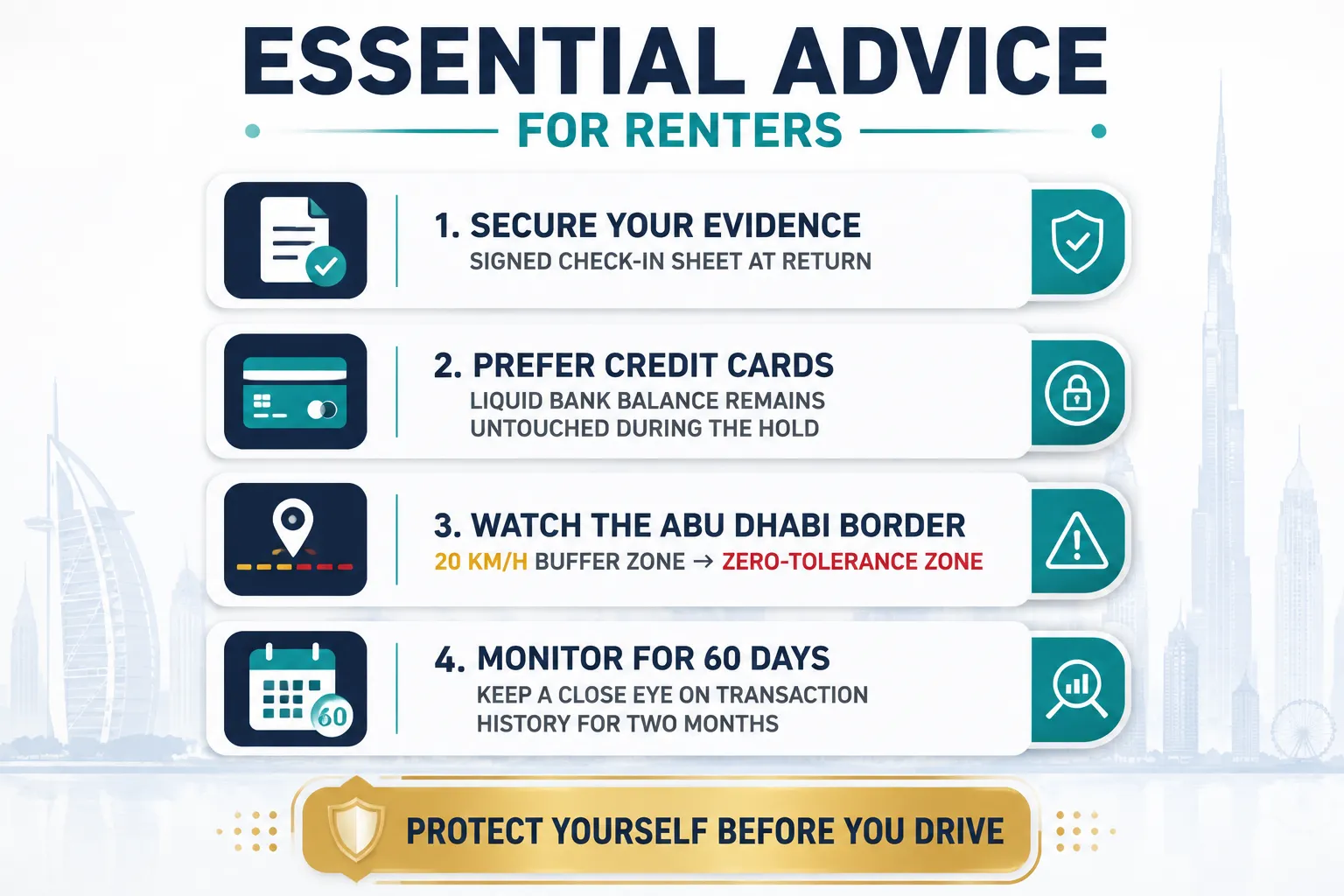
Key takeaways for renters
- Demand a paper trail. Always get a signed check-in sheet and a photo of the “No Fines” screen at drop-off.
- Use credit, not debit. A credit card hold does not reduce your actual bank balance the way a debit hold does.
- Mind the Abu Dhabi border. The commonly reported Dubai buffer does not apply once you cross into Abu Dhabi’s zero-tolerance enforcement.
- Monitor your card for 60 days. Set a reminder to check statements for two months after any Dubai rental ends.
- Ask about the admin fee upfront. It is the one part of any fine that varies by company, so it is worth comparing before you book.
Rent with confidence in Jumeirah
Understand the fine process, keep your documents, and monitor your card after returning the vehicle. Our team gives every renter a documented handover — no surprises at drop-off, no ambiguity if a fine ever needs checking.
Sources and methodology
Fine amounts, dispute windows and checking channels are referenced to Dubai Police and RTA published guidance. The Dubai speed-camera buffer is widely reported by multiple independent sources but is not an official, guaranteed allowance and can change without notice — treat the posted limit as the number that matters.
- Dubai Police — traffic fine inquiry and objections
- Roads and Transport Authority (RTA) — traffic fines and vehicle services
- Salik — Dubai toll gate charges
- The UAE Government portal (u.ae) — Ministry of Interior services
Disclaimer: fine amounts, enforcement policies and dispute procedures change. Confirm current figures with Dubai Police, the RTA, or your rental company before relying on any number in this guide.